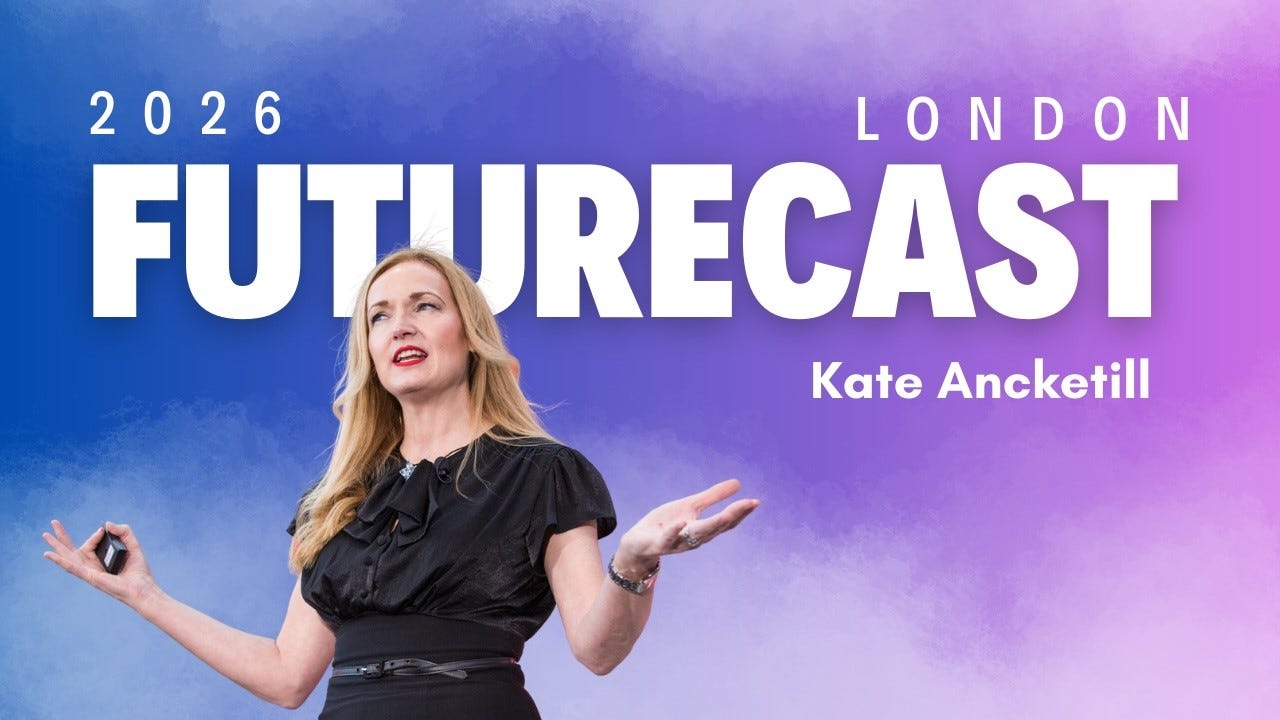
I was fortunate enough to attend FutureCast with GDR’s Kate Ancketill earlier this week. If you’ve never been to one of Kate’s sessions, I thoroughly recommend you do; they are always thought-provoking and informative.
And this one was no different; essentially, the keynote she would normally have given at NRF, was comprised of three major “big picture R&D labs” impacting the high street, retail, and daily life: AI and Robotics, Personal Superintelligence, and Trust in a Post-Truth World.
Here’s a write-up of what Kate covered:
1. AI and Robotics: High Street as Playgrounds and Laboratories
The high street is evolving into experimental “playgrounds” where retailers demonstrate cutting-edge AI and robotics, particularly relevant for beauty, health, and consumer electronics.
· Retail Automation: While exciting, the rise of robots presents challenges, especially concerning job displacement. Current applications include:
o Manufacturing: In-situ manufacturing for customized products (e.g., K-Beauty, where skin scans inform bespoke skincare creation, with a vision for Sephora to adopt this model).
o Food Preparation: Robots in kitchens and for delivery.
o Robo-Entertainment: Interactive robots for leisure.
o Back-end & Delivery: Standardized automation.
· Case Studies:
o tm:rw Store (Time Square): A consumer electronics store featuring a massive 17-foot HyperVision hologram, multiple levels, cafes, vending, and paid racing simulators, designed for immersive experiences.
o Chinese Robot Malls: Showrooms like “Robot Mall” in Beijing, where 69% of sales are for robot dogs used for home security (camera heads, remote access, cargo carrying), becoming increasingly affordable ($2800). Bipedal robots are mainly for show and industrial education due to safety concerns (heavy, dangerous around humans, struggle with real-world navigation).
o Robot Pharmacists (Estonia): Automated dispensing units operating as large vending machines, sometimes with semi-humanoid interfaces for theatre.
o Aescape (Robot Massage Machine): Offers deep tissue massage ($60 for 30 mins) using AI scans and a stretchy suit. Praised for effectiveness, affordability, and privacy compared to human massage.
The high street is integrating more healthcare and wellbeing services, moving beyond traditional retail.
· Longevity Clinics:
o Necco: Offers comprehensive body scans for health insights, with long waiting lists (100,000 people, up to a year wait for a £299 scan). Locations are rapidly expanding.
o Swedish Health Company Lab (Chelsea): Provides high street access to advanced treatments like hyperbaric oxygen and NAD+ infusions (thought to reverse cellular aging). These clinics are run by medical professionals, though some treatments like NAD+ infusions can be unpleasant.
· Extreme Longevity:
o Bryan Johnson (”Don’t Die” Movement): A tech billionaire dedicating millions annually to extreme longevity treatments. He promotes his “Blueprint” brand and the “Don’t Die” biohacking app, where users compete to improve health metrics, believing it can lead to indefinite human lifespan.
3. Personal Superintelligence: The Rise of AI Agents and Ambient Computing
The concept of “personal superintelligence” highlights the growing role of AI agents and contextually aware technology in daily life and commerce.
· AI Agents in Commerce: These agents research, compare, buy on behalf of users, and make entertainment shoppable.
o ChatGPT with Instant Checkout: Allows users to shop directly within the chatbot interface (e.g., Shopify, Etsy), leveraging saved payment details for frictionless purchasing.
o Sizzle App: Transforms social media videos (e.g., TikTok recipe videos) into shoppable recipes, allowing AI to scale, customize ingredients (e.g., vegetarian), and integrate with delivery services like Instacart or Amazon Fresh. Similar applications exist for travel videos.
· Anticipatory/Ambient AI & Wearables:
o Mark Zuckerberg’s Vision: Advocates for glasses as the ultimate device for personal superintelligence, as they see/hear what the user does and can provide real-time, contextually aware information via a visual interface.
o Meta Ray-Ban with Neural Band: New smart glasses offering live captions, translations, hands-free messaging, and camera control via a wristband, providing a private, glanceable display without needing to look at a phone. Offers significant benefits for accessibility (e.g., hard of hearing, visually impaired).
o OpenAI’s “Gumdrop” (Jony Ive Collaboration): Sam Altman and Jony Ive are developing a new category of AI device (not a phone or glasses, possibly a pen) that is ambient, voice-oriented, contextually aware, and crucially, has no screen. This aims to address the negative social impact of screen addiction and promote more natural human interaction.
o Razer’s Project Ava: A holographic AI assistant for gaming, providing real-time tips and advice.
3. Trust in a Post-Truth World: Rebuilding Authenticity
The proliferation of Generative AI (GenAI) raises significant concerns about fake content (deepfakes, AI-generated articles/videos), making trust increasingly difficult for brands to earn and maintain.
· Combatting Fake Content:
o Legislation: New laws are emerging to protect vulnerable groups from harmful AI-generated content (e.g., Australia’s social media ban for under 16s).
o Worldcoin (Sam Altman): Proposes iris scanning to create unique human identifiers, aiming to verify humanity online (to combat deepfakes) and potentially facilitate universal basic income (UBI) in a future post-work society.
· Radical Transparency:
o Yuka App: A highly popular app (55 million users, 1 in 3 French citizens) that allows users to scan food and beauty products to instantly see their chemical content and health score. This democratizes scientific information, leading brands to reformulate products based on Yuka’s ratings (e.g., a French clean beauty brand reformulated 70 substances). Yuka operates independently, accepting no affiliate payments, reinforcing its credibility. Users report better health and weight loss by avoiding low-scoring products.
· Retail as a Museum: In an era of online fakery, physical retail is experiencing a resurgence by emphasizing experiential, authentic storytelling. This means:
o Provenance + Entertainment: Flagship stores (e.g., Louis Vuitton “Ship” in Shanghai, Gucci brand museums) act like museums, highlighting a brand’s history, craftsmanship, and narrative to build authenticity and trust, a strategy applicable even to new brands with compelling founder stories.