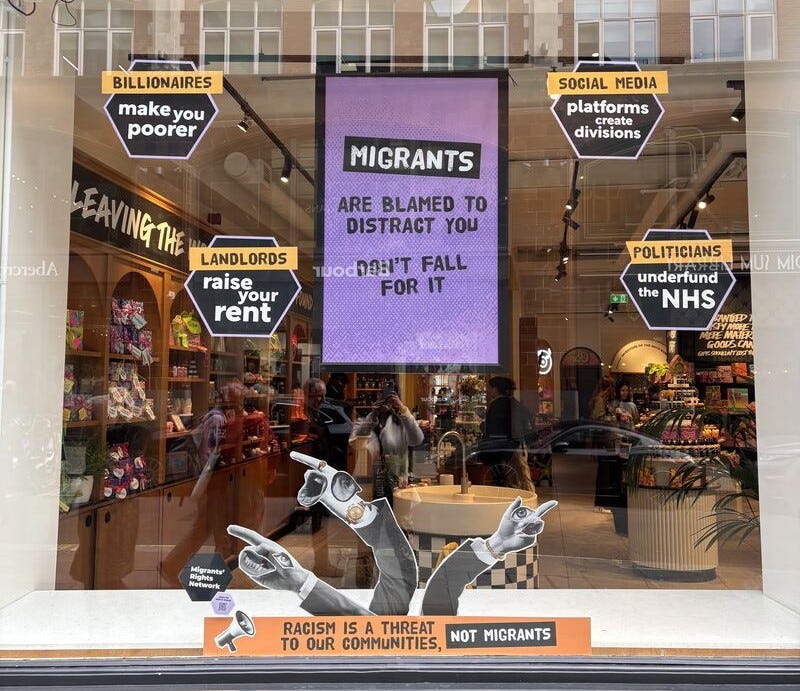
Image: Katy Trodd
Physical retail has always been about human connection and great experiences. It’s where brands meet customers, where products become experiences, and where trust is built. But one brand stands out for choosing to turn its shop windows into platforms for political messaging - and I, for one, have a sense of unease at this.
Last month’s campaign from Lush, which partnered with the Migrants’ Rights Network, argued that migrants are not the problem, instead pointing to politicians and billionaires as drivers of inequality. According to the company’s website, it was a “nationwide public awareness and fundraising campaign calling out the growing use of racist narratives to divide our communities and distract from the real issues people face across the UK”.
Mark Constantine, the co-founder of Lush, is known for using the company's platform and profits to fund and promote various political and social justice causes, often describing himself as a "woke nerd".
And the current geopolitical landscape is providing him with plenty of fodder. Past campaigns have included:
Solidarity with Gaza: In September 2025, Constantine led a campaign where Lush closed all its UK stores and its website for one day to protest starvation in Gaza. He later told critics of this position to stay away from his stores, stating he does not want support from customers who reject his stance.
Environmental Activism: Lush has also been a major financial backer of anti-badger culling activists and the “Frack Off” campaign in the UK
On the face of it, the message from this latest effort is entirely laudable, there being no place for racism in any shape or form. But more than that, is the shop floor really the right place for political debate?
Customers walk into stores to browse, discover, and buy. They’re not expecting to be confronted with political slogans while picking up a bath bomb or testing a new fragrance. When retail spaces become arenas for ideological messaging, the experience shifts from welcoming to potentially divisive. A risky move in an already challenging market.
Stores are open, public environments designed to attract the widest possible audience. Introducing politically charged narratives inevitably risks alienating some customers. What should be a straightforward, enjoyable shopping journey suddenly becomes a moment of tension. And being seen purchasing from a store carrying such messaging inevitably infers some kind of tacit support for the cause on the part of the customer.
Then there’s the impact on store teams. Retail colleagues are there to help customers, provide product knowledge, and deliver service - not to field questions on immigration policy or economic inequality. Yet when political messaging is placed front and centre, staff can find themselves drawn into conversations they didn’t sign up for and aren’t equipped to handle. At a time when abuse and violence towards frontline retail staff are at epidemic proportions, that’s not only unfair and potentially unsafe, it’s unwise to say the least.
Retail environments should feel comfortable, inclusive, and enjoyable. They should encourage exploration and purchasing, not debate. While brands absolutely should have values - and increasingly customers expect them to - there’s a difference between living those values and broadcasting overt political positions in-store.
History shows that retail activism often generates noise and headlines (which this particular campaign most certainly has), but noise doesn’t always translate into loyalty. Polarisation may drive short-term attention, but long-term success depends more on stable relationships with customers. Division, by definition, makes that harder.
What this does, however, is raise the question: what does responsible retailing look like? Most would agree that this should include fair treatment of employees, sustainable supply chains, and meaningful community engagement. These qualities unite rather than divide. They build trust, the very lifeblood for any brand.
Ultimately, the shop floor has one job: to create an environment where customers feel welcome and inspired to buy. Politics has its place - in public forums, debates, and democratic institutions, but not on the shop floor.